
When a voice grows quiet, the words are still there — they just stop carrying. For millions of people living with Parkinson’s disease, ALS, vocal cord paralysis, and other voice disorders, the hardest part of a conversation isn’t finding what to say. It’s being heard across the dinner table, in a busy restaurant, or on the phone with a grandchild. Repeating yourself is exhausting. Being asked “what?” for the tenth time is discouraging. And for many people, the quiet creep of a soft voice leads to something worse: withdrawing from conversation altogether.
A personal voice amplifier is one of the simplest, most practical tools for keeping a soft voice in the conversation. This guide explains why voices lose volume, what the published research says about gentle amplification, what speech-language pathologists look for in a speech amplifier, and how to choose and fund a ChatterVOX® — the original portable voice amplifier, built for exactly this purpose since 1998.
A note before we start: this article is educational, not medical advice. A voice amplifier is an assistive communication tool — it does not treat, cure, or slow any condition. If you or a loved one is experiencing voice changes, please talk with your doctor and a speech-language pathologist (SLP) about the right combination of therapy and tools for your situation.
Why Voices Get Quiet
A weak voice is rarely about effort. It usually comes down to the mechanics of breath, vocal fold movement, and the muscles that coordinate speech. Different conditions get there by different routes.
Hypophonia in Parkinson’s disease
Reduced speech volume — called hypophonia — is one of the most common communication changes in Parkinson’s disease. A large majority of people with PD experience reduced speech volume or intelligibility at some point. What makes it especially tricky is that the speaker often doesn’t hear the change: to the person with Parkinson’s, their voice sounds normal, while family members lean in and strain. The result is a frustrating loop — listeners ask for repeats, the speaker feels nagged, and conversations get shorter.
ALS and vocal fatigue
Speaking at conversational volume takes real physical work: breath support from the diaphragm, sustained muscle control in the larynx, articulation in the lips and tongue. For people living with ALS, that work becomes progressively more tiring. Even when speech is still intelligible, holding volume through a full conversation can drain energy that’s needed elsewhere. A speech amplifier for ALS doesn’t restore muscle function — but it lets a person speak at a lower, less fatiguing effort level while still being heard.
Vocal cord paralysis, dysarthria, and dysphonia
When one or both vocal folds don’t move or close properly — vocal cord paralysis — the voice often comes out breathy, weak, and hard to project. Dysarthria, a motor speech disorder, can reduce both volume and clarity. Spasmodic dysphonia can make the voice strained and effortful, so that projecting feels like a fight. Vocal nodules and similar conditions often come with medical guidance to stop pushing the voice, which leaves people wondering how to be heard at all.
Recovering after throat surgery
After surgery involving the throat or larynx, many people are advised to protect the voice during recovery — speak gently, don’t strain, don’t shout. Amplification can bridge that period, letting someone stay present in family life and work conversations without working against their recovery instructions.
How Gentle Amplification Helps Daily Communication
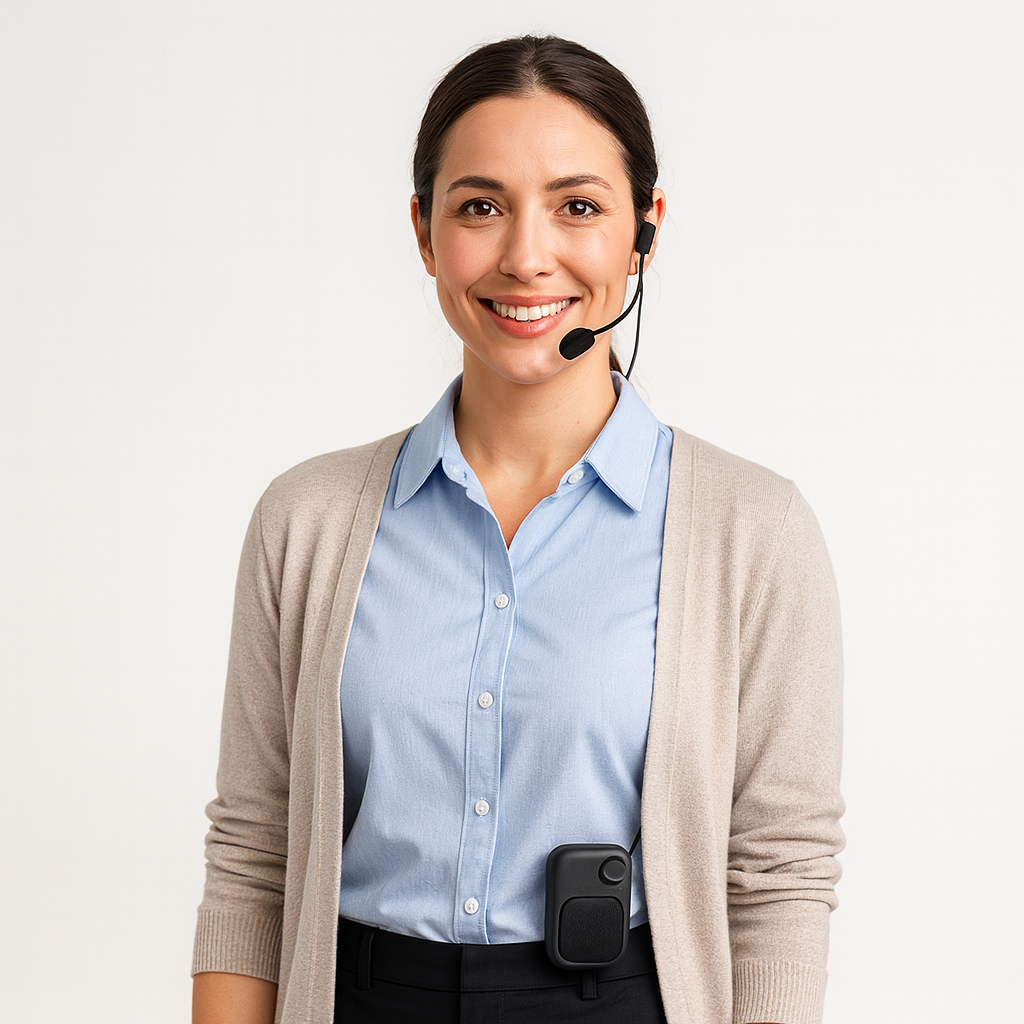
The idea behind a personal voice amplifier is almost disarmingly simple: a small headset microphone picks up your voice right at its source, and a wearable speaker gives it a gentle boost — on the classic ChatterVOX waistband platform, up to about 15 dB. You speak at whatever level is comfortable and sustainable; your listener hears you clearly. The amplifier does the projecting so your vocal folds don’t have to.
This isn’t just a plausible-sounding theory — it’s been measured. In a study published in the Journal of Voice, McCormick & Roy (2002) found that when speakers used a ChatterVox, their own vocal intensity at the mouth dropped by roughly 6 dB SPL — while the loudness reaching the back of a classroom actually rose by about 2.5 dB SPL. In plain terms: people spoke noticeably softer and were heard noticeably better. For anyone whose voice tires easily or shouldn’t be strained, that trade is the whole point.
A second study looked specifically at Parkinson’s. Andreetta and colleagues (2016), writing in the American Journal of Speech-Language Pathology, compared seven commercially available speech amplifiers for people with Parkinson’s disease speaking in background noise. Amplification made a dramatic difference to how well listeners understood the speakers — aggregate intelligibility improved from 13.8% to 58.9% across devices. And among the seven amplifiers tested, ChatterVox received the highest average user rating for sound quality.
Two studies, two consistent findings: gentle amplification lets a soft voice reach its listeners, and it does so while reducing the effort the speaker puts in — not increasing it.
What Speech-Language Pathologists Look For in a Voice Amplifier
SLPs have been recommending voice amplifiers — and ChatterVOX specifically — for decades, and they tend to evaluate them on practical grounds rather than spec sheets. If you’re comparing options, these are the questions worth asking:
- Does it reproduce speech naturally? A voice amplifier should be tuned for the human voice, not for music playback. Many inexpensive amplifiers sold online are essentially tiny PA speakers; a purpose-built speech amplifier keeps the voice sounding like the person, which matters enormously for daily conversation.
- Are the controls simple? For someone managing tremor, fatigue, or reduced dexterity, a device with one obvious volume control beats a device with menus. Turn it on, set the level, talk.
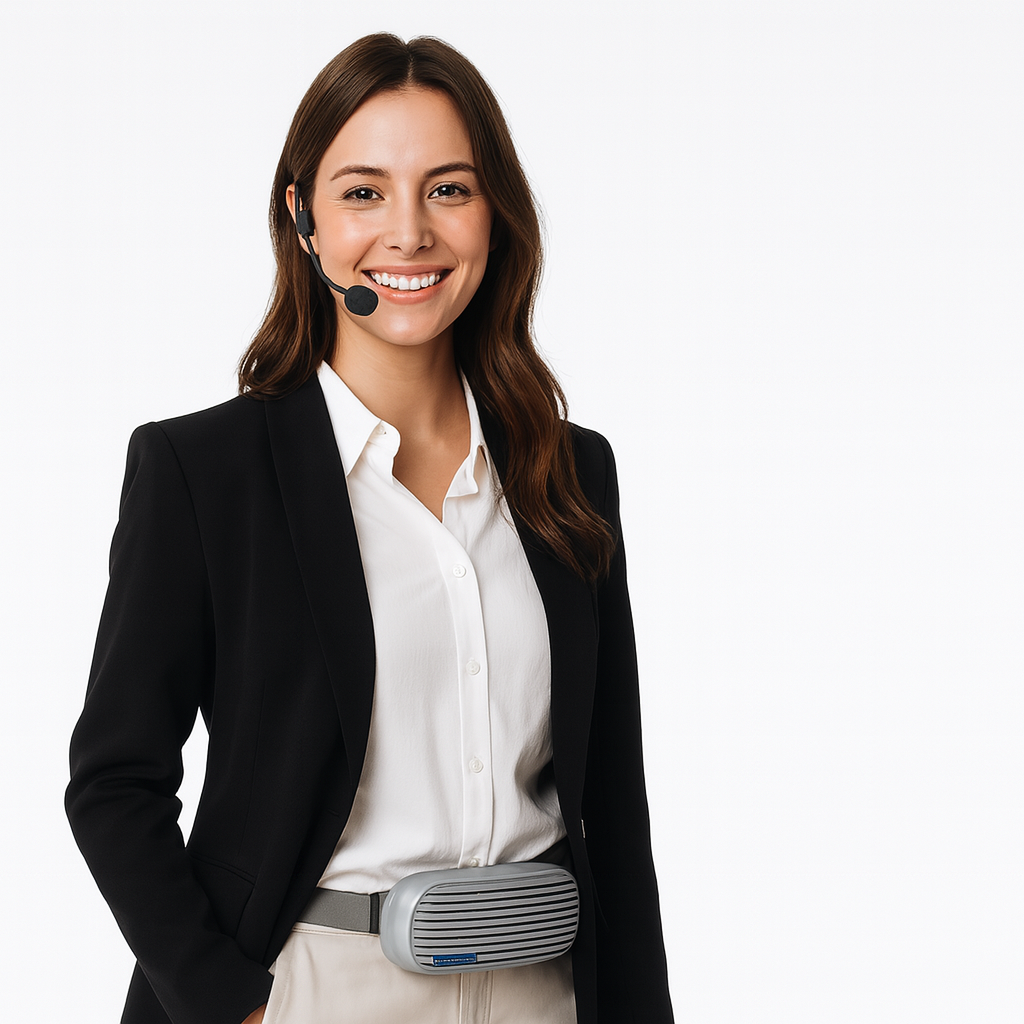
- Is it comfortable to wear all day? The classic ChatterVOX waistband system weighs about a pound and sits at the hip, leaving both hands free. If a device is annoying to wear, it ends up in a drawer.
- Is the microphone dependable? A wired headset microphone never needs pairing, never drops out mid-sentence, and never picks up interference. For a device someone relies on every day, that boring reliability is a genuine feature.
- Can it be serviced? ChatterVOX systems are supported with genuine replacement parts — batteries, microphones, cables, belts — through a US-based service center (ELT Service Center: 800-286-3481), and every amplifier and microphone carries a 1-year warranty. Many generic amplifiers are effectively disposable.
Choosing a ChatterVOX® for Personal Use
For most people with a weak or easily tired voice, the choice comes down to daily-wear comfort and simplicity.
The ChatterVOX® Pro with Headset Mic ($199, regularly $279) is the classic recommendation for personal, all-day use. It’s worn at the waistband, the headset microphone keeps both hands completely free, and the rechargeable battery is built to last through a full day of conversation. It’s the same fundamental system SLPs have trusted for years — for the dinner table, the phone, errands, appointments, and everything in between.
The ChatterVOX® Model 6 ($279, regularly $349) is the outdoor and high-demand option — a hip-worn amplifier originally built for PE teachers and coaches. It’s worth considering if you spend a lot of time outdoors or in genuinely noisy environments, though for everyday personal use it’s more amplifier than most people need.
And there’s one worth watching: the next-generation ChatterVOX® Amplio is coming soon — lighter, sleeker, and smarter, with cleaner sound and an all-day rechargeable battery. For anyone who wants amplification that’s as discreet as possible, the Amplio will be the one to look at when it arrives.
Not sure which fits your situation? The Help Me Choose tool walks through it in a couple of minutes, and our Amplio vs. Pro vs. Model 6 comparison lays the models side by side. If you’re an SLP or educator purchasing through a school or district, you’ll find ChatterVOX® at SchoolPHONES®, the authorized education retailer.
Practical Tips for Everyday Use
A few habits make an enormous difference in how well any voice amplifier works day to day:
- Wear the mic at the corner of your mouth — never directly in front. Positioning the boom at the corner of the mouth avoids popping and breath noise while still catching the voice cleanly. This one adjustment fixes most sound-quality complaints.
- Use the minimum volume that works. Set the amplifier just loud enough for your listeners. Minimum effective volume sounds more natural and avoids feedback.
- Charge daily. Make the charger part of the bedtime routine so the amplifier is always ready. The classic platform runs on rechargeable NiMH AA batteries with up to 14 hours per charge — and in a pinch, ordinary alkaline AAs work as a backup, which is a reassuring safety net for travel.
- Make wearing it routine. An amplifier only helps when it’s on. Putting it on in the morning like a watch or glasses removes the daily decision.
Our step-by-step ChatterVOX setup guide covers first-day setup and mic positioning in detail, and the batteries, parts & care guide covers keeping a system healthy for years.
Paying for a Voice Amplifier: Medicare and Other Funding
Here’s a fact that surprises many families: Medicare can cover voice amplifiers. According to the American Speech-Language-Hearing Association (ASHA), voice amplifiers may be covered under Medicare’s prosthetic devices benefit — billed under HCPCS code L8510 — when larynx function is impaired but still present. Coverage always depends on individual circumstances and documentation, so the practical path is to talk with your SLP and a Medicare-enrolled supplier about whether your situation qualifies and what paperwork is needed.
Beyond Medicare, many states run assistive-technology programs and device lending libraries, and some of them carry ChatterVox systems. A lending library can be a genuinely great first step: borrow an amplifier, try it in real life for a few weeks, and confirm it helps before anyone spends a dollar. Your SLP or your state’s AT program can point you to what’s available locally.
Built for a Friend: The ChatterVOX® Assistive Heritage
ChatterVOX didn’t start as a classroom product that later found assistive users — it was the other way around. In the late 1990s, the first ChatterVox was conceived to help one man, the late Al Shulman, keep his active lifestyle despite Parkinson’s disease. It was developed with the vision and support of Siemens’ Professional Products division, headed by the late David Sutton, and it has since touched the lives of more than 50,000 people.
Today ChatterVOX® is a registered trademark of Ted Simons and a product of Enhanced Listening Technology Corp. in Nashville, Tennessee — and chattervox.store is its official online home. That heritage matters in a market crowded with lookalike amplifiers: this is a device that has been purpose-built, refined, and serviced for people with voice challenges for more than 25 years. If you’re buying, our how to buy a real ChatterVOX checklist shows how to make sure you’re getting the genuine article with its warranty and US-based support behind it.
FAQ
Can a voice amplifier help with Parkinson’s soft speech?
Many people with Parkinson’s-related soft speech (hypophonia) find a personal voice amplifier makes daily conversation easier. In a 2016 study in the American Journal of Speech-Language Pathology, amplifiers substantially improved how well listeners understood speakers with Parkinson’s in noise, and ChatterVox earned the highest average user rating for sound quality. An amplifier is an assistive tool, not a treatment — talk with your SLP about pairing it with voice therapy.
Does Medicare cover a voice amplifier?
It may. Per ASHA, Medicare can cover voice amplifiers under the prosthetic devices benefit (HCPCS code L8510) when larynx function is impaired but present. Coverage depends on your individual situation and documentation, so check with your SLP and a Medicare-enrolled supplier. Some state assistive-technology programs and lending libraries also offer amplifiers to borrow or trial.
Which ChatterVox is best for a weak voice?
For most personal, all-day use, the ChatterVOX Pro with Headset Mic is the classic choice — waistband-worn, hands-free, and rechargeable with all-day battery life. The next-generation ChatterVOX Amplio, coming soon, will be lighter and sleeker for those who want something more discreet. The Help Me Choose tool on chattervox.store can match a model to your situation.
Will an amplifier strain my voice more?
The goal is the opposite. A 2002 Journal of Voice study found that speakers using a ChatterVox lowered their own vocal intensity by about 6 dB while listeners at the back of a room heard them about 2.5 dB louder — speaking softer, heard better. Use the minimum volume that works and follow your SLP’s or doctor’s guidance about your voice.
Is ChatterVox a medical device?
No. ChatterVox is an assistive personal voice amplifier — it amplifies your natural voice but does not treat, cure, or diagnose any condition. If you’re experiencing voice changes, see your doctor and a speech-language pathologist; they can advise whether amplification fits into your overall communication plan.



Leave a Reply