
Ask a speech-language pathologist to name a portable voice amplifier and there is a good chance the first word out of their mouth is “ChatterVOX.” Since 1998, ChatterVOX® has been the original personal voice amplifier: a small, wearable speaker-and-microphone system that lets you talk at a relaxed, conversational level and still be heard clearly across a classroom, a gym field, a museum gallery, or a busy sidewalk. Over more than 25 years, it has touched the lives of more than 50,000 people — teachers and coaches, tour guides and auctioneers, and people managing voice changes from Parkinson’s disease and other conditions.
This is the definitive introduction to ChatterVOX, published here at chattervox.store — the official online home of the brand. Below you’ll find how a personal voice amplifier actually works, the story of how ChatterVOX began, the clinical research behind it, the model timeline from the original waistband unit to the next-generation Amplio, and the current official lineup.
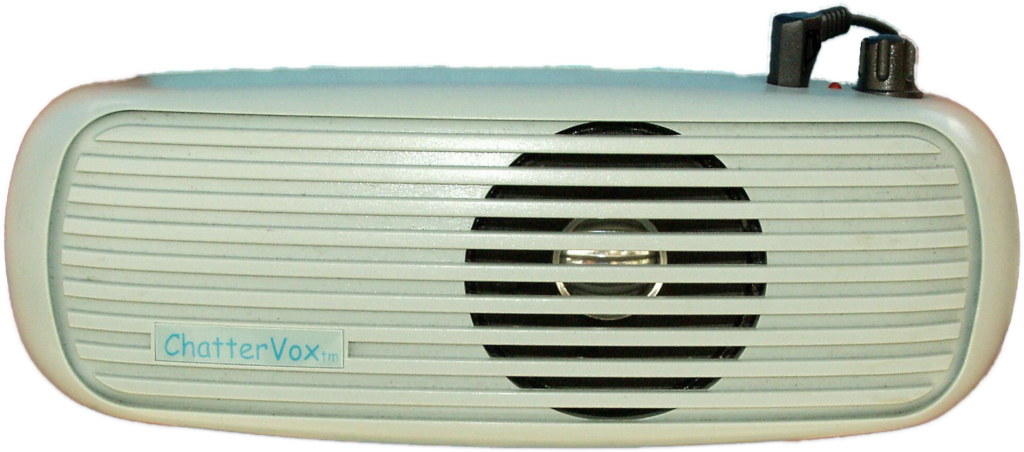
What Is a Personal Voice Amplifier — and What Makes ChatterVOX Different?
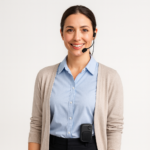
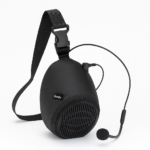
A personal voice amplifier is exactly what it sounds like: a compact amplifier and speaker you wear on your body, connected to a lightweight microphone positioned near your mouth. The classic ChatterVOX design is worn at the waistband, weighs about a pound, and pairs with a hands-free headset microphone. You speak normally; the speaker projects your voice outward, so listeners hear you as if you had raised your voice — without you actually raising it.
The boost is deliberately gentle. With the headset mic, the classic waistband ChatterVOX lifts your voice by up to about 15 dB — enough to carry a soft, conversational voice to the back of a room, but nothing like the blare of a public-address system. That restraint is the point. ChatterVOX was purpose-built for natural speech, not music playback or crowd announcements, so voices come through sounding like voices rather than loudspeaker noise.
The practical details follow the same philosophy. The classic platform runs on rechargeable NiMH AA batteries for up to 14 hours per charge, and ordinary alkaline AAs work as a backup if you’re ever caught without a charger. The headset boom is worn at the corner of the mouth — never directly in front of it — which avoids popping and breath noise, and using the minimum volume you actually need keeps feedback away. Our step-by-step ChatterVOX setup guide walks through all of it in a few minutes.
The Origin Story: One Man’s Voice
ChatterVOX was conceived in the late 1990s to solve one person’s problem. The late Al Shulman was determined to keep his active lifestyle despite Parkinson’s disease — but like a large majority of people with Parkinson’s, he experienced reduced speech volume that made everyday conversation an uphill battle. What he needed didn’t really exist yet: a wearable amplifier gentle enough for natural speech and simple enough to wear all day, every day.
The idea became a real product with the vision and support of the Siemens Professional Products division, headed by the late David Sutton. The result, introduced in 1998, was the original ChatterVOX waistband amplifier. Today, ChatterVOX® is a registered trademark of Ted Simons and a product of Enhanced Listening Technology Corp. (ELT) of Nashville, Tennessee — and the device built to help one man keep his voice has gone on to help more than 50,000 people speak comfortably and be heard.
Speak Softer, Be Heard Better: What the Research Shows
ChatterVOX is one of the few personal voice amplifiers with published, peer-reviewed research behind it. In a 2002 study in the Journal of Voice, McCormick and Roy asked whether the ChatterVox could reduce the “vibration dose” a speaker’s vocal folds absorb during heavy voice use. The result was striking: with the ChatterVox, speakers’ own vocal intensity at the mouth dropped by roughly 6 dB SPL, while loudness at the back of a classroom actually rose by about 2.5 dB SPL. In plain terms, users spoke more softly and were heard better at the same time.
A second line of evidence comes from Parkinson’s research. In a 2016 study in the American Journal of Speech-Language Pathology, Andreetta and colleagues compared seven speech amplifiers used by people with Parkinson’s disease speaking in background noise. Amplification dramatically improved intelligibility overall — from 13.8% to 58.9% in aggregate — and the ChatterVox earned the highest average user rating for sound quality of all the devices tested.
Findings like these are a big part of why speech-language pathologists have recommended ChatterVOX for decades, both for clients with voice conditions and for heavy occupational voice users such as teachers. If that’s you, our guides on voice amplifiers for Parkinson’s, ALS, and other voice disorders and choosing an amplifier for large classrooms go deeper into both topics.
The ChatterVOX Timeline: 1998 to the Next Generation
More than 25 years in, the ChatterVOX family still follows the template the original set: wearable, hands-free, tuned for natural speech. Here’s how the line has evolved.
- Late 1990s — the original waistband amplifier. The system that started it all: about a pound on the waist, a gentle lift of up to roughly 15 dB through a headset mic, and up to 14 hours on a charge of rechargeable NiMH AAs. Every ChatterVOX since has been built on this idea.
- 2010 — the Model 6. A tougher, more powerful hip-worn amplifier created for PE teachers, coaches, tour groups, and other outdoor or harsh environments where the classic unit was being pushed to its limits.
- 2012 — the Amplio line. A compact generation of amplifiers. The name comes from the Latin amplio: to enlarge, magnify, augment — a fitting description of what the product does for a quiet voice.
- Coming soon — the next-generation Amplio. The newest chapter: lighter, sleeker, and smarter, with cleaner sound and an all-day rechargeable battery.
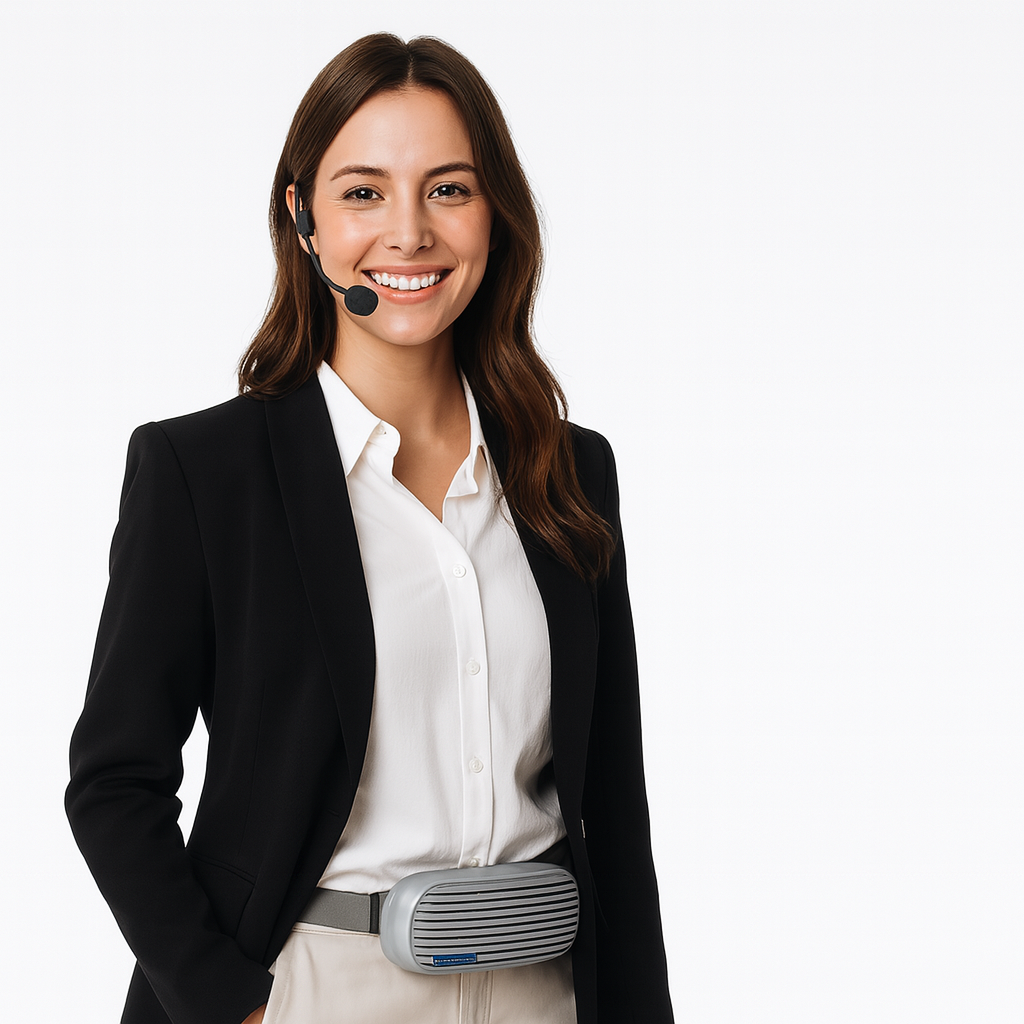
The Current Official ChatterVOX Lineup
Three systems make up the current official range, each aimed at a different kind of speaking day.
ChatterVOX® Pro with Headset Microphone — $199
The ChatterVOX Pro with headset mic ($199, regularly $279) is the classic teacher-and-presenter system: worn at the waistband, completely hands-free, rechargeable, and built for all-day battery life. If you picture “a ChatterVOX” in your head, this is it — the direct descendant of the original 1998 design, refined across two decades of daily classroom use.
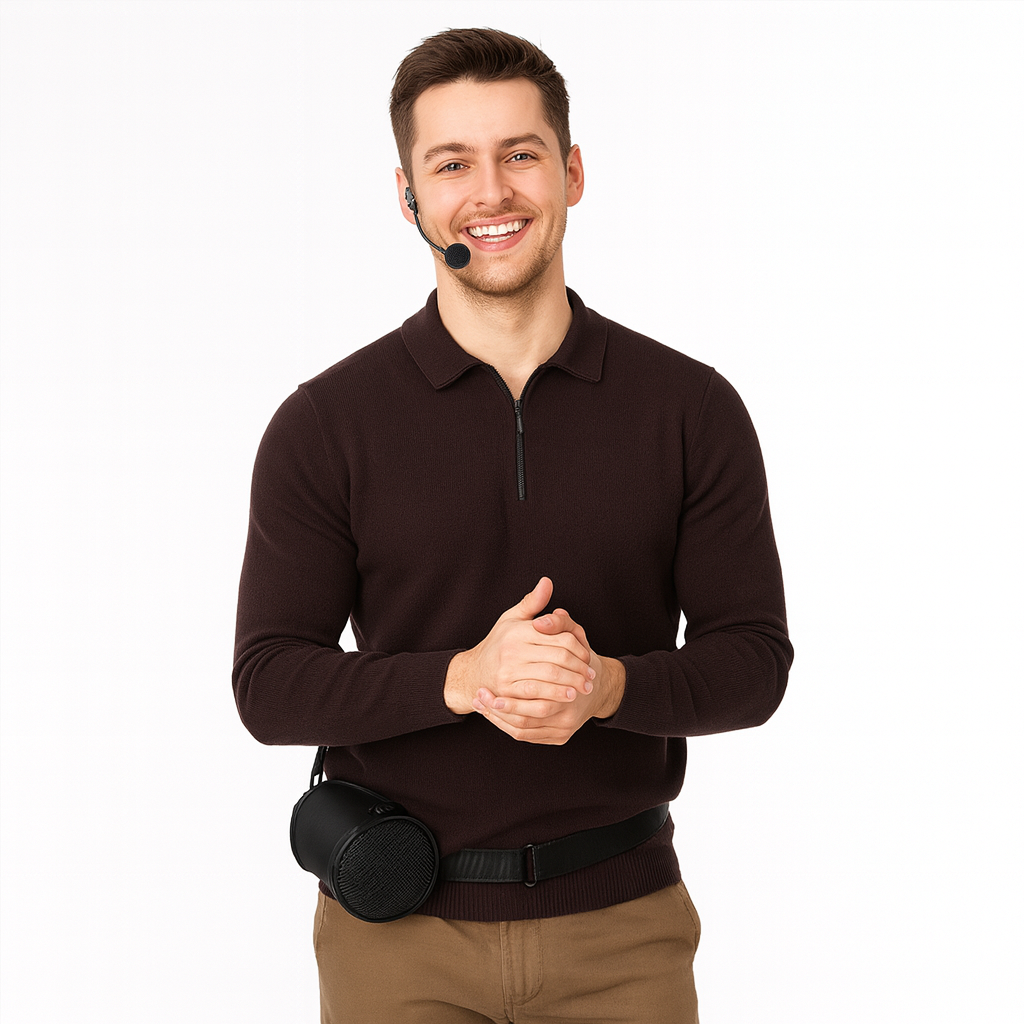
ChatterVOX® Model 6 Coaching Amplifier — $279
The ChatterVOX Model 6 coaching amplifier ($279, regularly $349) is the outdoor workhorse. It pairs a 6.0-watt RMS Class D amplifier with a 3.5-inch 4-ohm speaker and the HM150 Series Sweatguard condenser headset microphone, and it ships with four 2300mAh NiMH rechargeable batteries, a neoprene amp cover, an internationally compatible charger, and a storage bag. Worn on the hip, it projects sound in whatever direction the speaker faces — including rearward, which makes it a favorite for follow-the-leader activities like group hikes, ski lessons, and walking tours.
ChatterVOX® Amplio — Next Generation, Coming Soon
The next-generation ChatterVOX Amplio is on its way: lighter, sleeker, and smarter than anything ChatterVOX has built before, with cleaner sound and an all-day rechargeable battery. Full specifications and pricing haven’t been announced yet — watch this site for updates, because official news lands here first.
Not sure which model fits your day? Start with our Help Me Choose tool, or read the detailed Amplio vs. Pro vs. Model 6 comparison.
Who Uses ChatterVOX?
Professionals who talk for a living
Anyone whose workday is one long speaking engagement is a candidate. Teachers and professors use ChatterVOX to get through six periods without going home hoarse. PE teachers, coaches, and fitness and aerobics instructors rely on it outdoors and over gym echo. Tour guides and museum docents — including guides at the Statue of Liberty — use it to keep groups together without shouting; our guide for tours and museums covers that world in detail. Auctioneers, presenters, corporate trainers, band and choral directors, and law enforcement officers round out a user base that has one thing in common: hours of talking, every single day.
People with voice conditions
The other half of the ChatterVOX story is the one it was born from. A large majority of people with Parkinson’s disease experience reduced speech volume and intelligibility, and a wearable amplifier can make conversation practical again. People living with ALS, dysarthria, vocal cord paralysis, vocal nodules, or spasmodic dysphonia — and people recovering after throat surgery — use ChatterVOX for the same reason: it makes a quiet voice easier to hear. To be clear, ChatterVOX is not a medical device and does not treat or cure any condition; always talk with your physician or speech-language pathologist about what’s right for your situation.
On the funding side, Medicare may cover voice amplifiers under the prosthetic devices benefit (HCPCS code L8510) when larynx function is impaired but still present, according to ASHA — your SLP and supplier can help you sort out eligibility. Some state assistive-technology programs and lending libraries also carry ChatterVox units you can try before buying. Our article on voice amplifiers for Parkinson’s and ALS has more on all of this.
Why chattervox.store Is the Official Home of ChatterVOX
Search “voice amplifier” on any big marketplace and you’ll wade through pages of generic look-alike gadgets. The honest differences are qualitative but real: ChatterVOX has a 25-plus-year track record and decades of familiarity among speech-language pathologists; it uses a wired microphone, so there’s no pairing, no dropouts, and no wireless interference; it’s serviceable, with genuine replacement batteries, microphones, cables, and belts available (see the batteries, parts, and care guide); it’s backed by a US-based service center — the ELT Service Center at 800-286-3481 — and it carries a one-year warranty on the amplifier and microphone from the date of purchase.
That’s also why this site exists. chattervox.store is the official online home of ChatterVOX®: the source for official product information, brand updates, and information on official ChatterVOX retailers. You can buy directly from the official shop, and if you’re evaluating a listing somewhere else, run it through our how-to-buy-a-real-ChatterVOX checklist first. Schools and districts have their own dedicated channel: ChatterVOX® at SchoolPHONES®, the authorized education retailer. And if you have a question the site doesn’t answer, contact us — or browse the rest of the ChatterVOX guides.
FAQ
Is chattervox.store the official ChatterVOX site?
Yes. chattervox.store is the official online home of ChatterVOX® — the source for official product information, brand updates, and details on official ChatterVOX retailers. For school and district purchasing, SchoolPHONES® is the authorized education retailer.
Who makes ChatterVOX?
ChatterVOX® is a registered trademark of Ted Simons and a product of Enhanced Listening Technology Corp. (ELT) of Nashville, Tennessee. The brand dates to 1998, and the US-based ELT Service Center can be reached at 800-286-3481.
How loud is a ChatterVox?
The classic waistband ChatterVox gives a gentle boost of up to about 15 dB with its headset microphone — enough to carry a relaxed, conversational voice clearly across a classroom, but well short of public-address volume. Published research found speakers could actually lower their own vocal intensity by about 6 dB SPL while listeners at the back of the room heard them about 2.5 dB SPL better.
Where can I buy a ChatterVox?
Genuine ChatterVOX systems are available from the official shop at chattervox.store, which also lists official retailers. Schools and districts can buy through SchoolPHONES®, the authorized education retailer. If you’re considering a listing elsewhere, verify the seller against the official retailer information on this site first.
Does Medicare cover a ChatterVox voice amplifier?
It may. According to ASHA, Medicare can cover voice amplifiers under the prosthetic devices benefit (HCPCS code L8510) when larynx function is impaired but still present. Coverage depends on your individual situation, so talk with your speech-language pathologist and your supplier about eligibility and documentation.


Leave a Reply